“If I don’t know I don’t know
I think I know
If I don’t know I know
I think I don’t know“
– R. D. Laing (1970)
Exploring the Potential of Polar Mixed-Phase Cloud Thinning for Climate Geoengineering
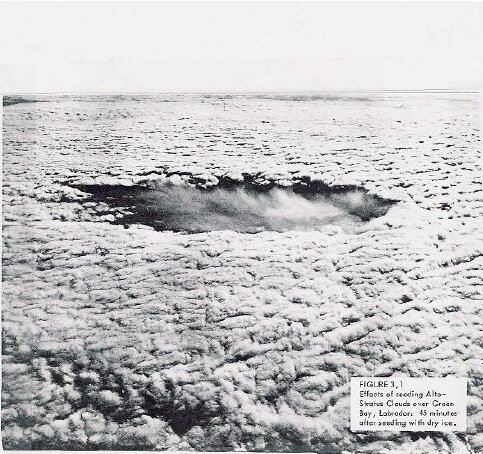
Addressing climate change risks requires thinking in three dimensions: mitigation, adaptation, and climate geoengineering. The latter typically encompasses carbon dioxide removal and solar geoengineering. I aim to provide robust scientific support for one solar geoengineering strategy – polar cloud geoengineering. Questions I ask and will thoroughly investigate include how seeding widespread polar stratus-like clouds (similar to the one shown in the left photo) could influence critical tipping elements, such as Arctic sea ice loss, Greenland ice sheet melting, permafrost degradation, tundra loss, and AMOC slowdown.
Could Sea Ice Leads Hold the Key to Explaining the Long-standing Bias of Polar Low Clouds in GCMs?
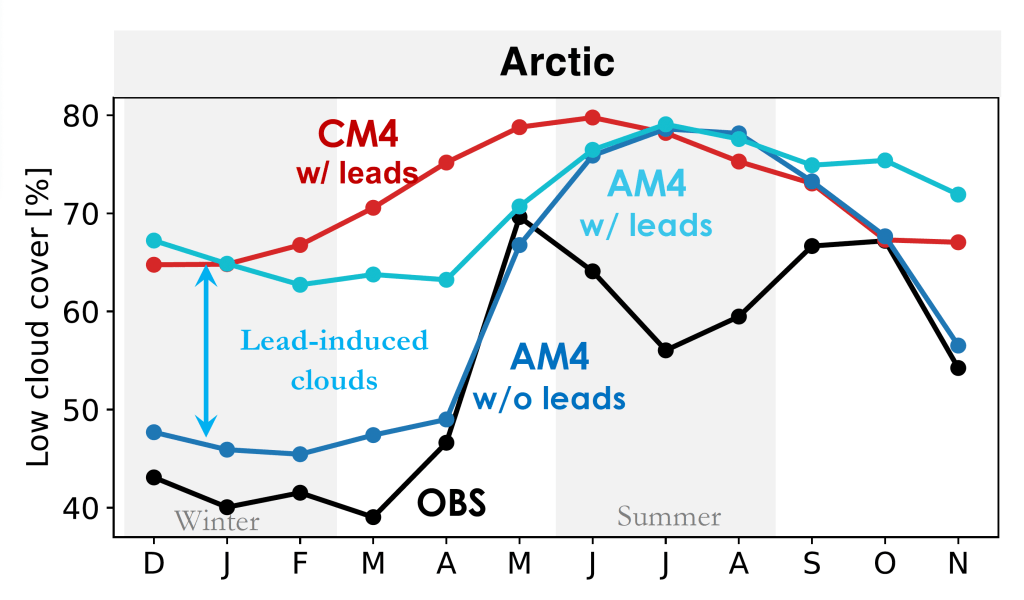
Climate models have long struggled to accurately simulate both present-day and future cloud properties in polar regions, particularly low-level mixed-phase clouds. These clouds present unique challenges due to their composition of both liquid droplets and ice crystals, their close interaction with heterogeneous surfaces, and their governance by large- and cloud-scale dynamics. As a result, climate models must not only incorporate advanced microphysical parameterizations but also capture the full range of interactions and feedbacks among clouds, turbulence, surface fluxes, aerosols, radiation, and large-scale transport processes that drive the life cycle of low-level clouds. In this project, our efforts isolate and identify a poorly understood process that may significantly impact cloud representation in models – the subgrid processes associated with sea ice leads and their coupling with low clouds, particularly during non-summer seasons.
- Li, X., Tan, Z., Zheng, Y., Bushuk, M., & Donner, L. J. (2023b). Open Water in Sea Ice Causes High Bias in Polar Low‐Level Clouds in GFDL CM4. Geophysical Research Letters, 50, e2023GL106322.
- Li, X., et al. (in preparation). Small differences in sea ice concentration amplify low-level cloud discrepancies between CMIP6’s CMIP and AMIP simulations.
Quantifying and Understanding the Full Spectrum of Radiative Effects of Arctic Low Clouds

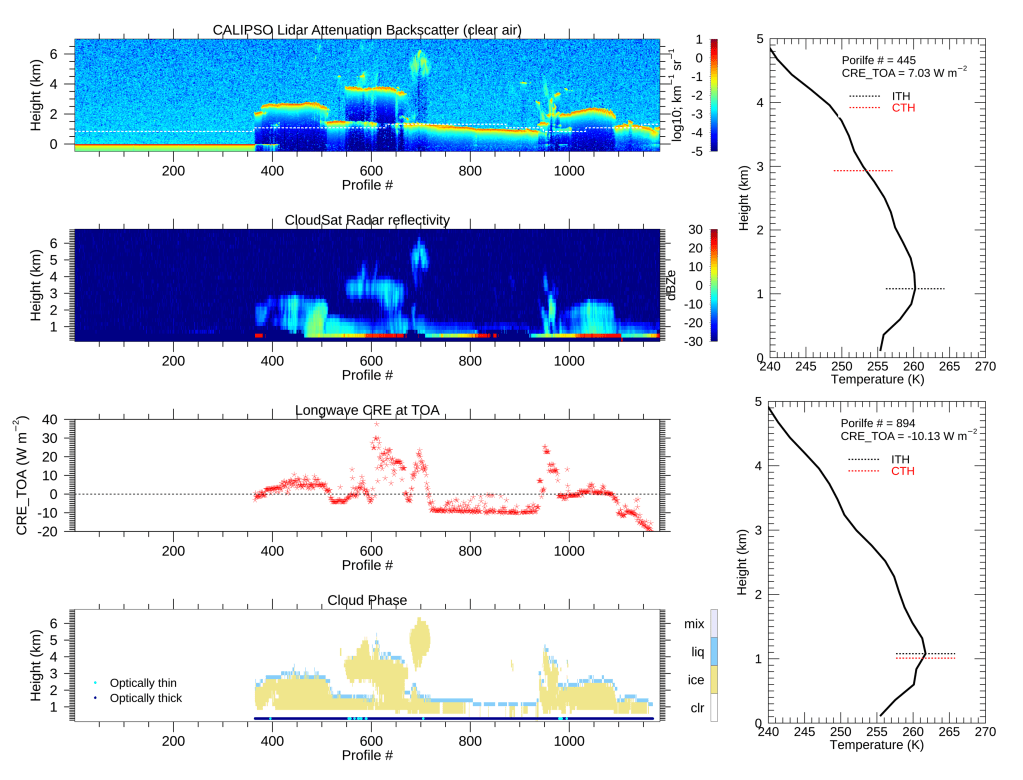
The Arctic has become emblematic of climate change, yet major uncertainties consistently persist in our ability to understand and predict Arctic climate, particularly concerning the radiative effects of clouds. By leveraging active satellite cloud observations from radar and lidar, we aim to quantify the full spectrum of radiative effects of Arctic low clouds, providing a comprehensive understanding of their radiative influence at the surface, atmosphere column, and TOA.
- Li, X., Mace, G. G., Strong, C., & Krueger, S. K. (2023a). Wintertime cooling of the Arctic TOA by low-level clouds. Geophysical Research Letters, 50, e2023GL104869.
Understanding the Impacts of Sea Ice Leads on Arctic Low Clouds
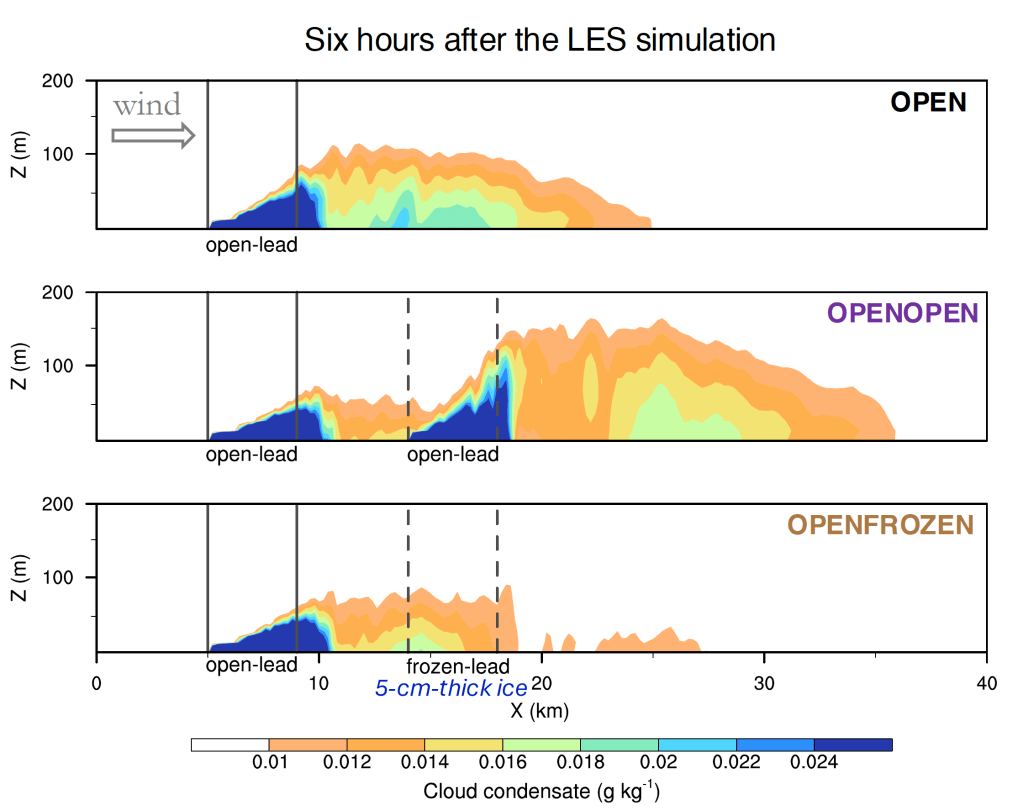
Sea ice leads (cracks) play a crucial role in the Arctic boundary layer as they contribute ~50% of heat loss from the ocean to the atmosphere in winter pack ice regions, thereby affecting boundary layer cloudiness and structure. Given that Arctic low clouds have a first-order impact on the surface energy budget and sea ice cracks are likely to become more frequent in a new Arctic, it is imperative to understand the modulators of these clouds, such as sea ice leads. In this work, we aim to address two key questions: What is the influence of sea ice leads on low cloud properties during the wintertime, when large surface-air temperature differences exist? And what physical mechanisms govern the interactions between leads and low-level clouds? These efforts aim to identify previously overlooked processes related to lead-cloud coupling, which are critical to advancing our understanding of the complex Arctic system and its climate.
- Li, X., Krueger, S. K., Strong, C., Mace, G. G., & Benson, S. (2020a). Midwinter Arctic leads form and dissipate low clouds. Nature Communications, 11(1), 1-8. [ScienceDaily][UNews][Phys.org][EurekAlert][Eurasia Review]
- Li, X., Krueger, S. K., Strong, C., & Mace, G. G. (2020b). Relationship Between Wintertime Leads and Low Clouds in the Pan‐Arctic. Journal of Geophysical Research: Atmospheres, 125(18), e2020JD032595.
 Xia Li